




Plastic Masonry Wall Plugs | General Purpose Expansion Plugs for Brick, Block & Concrete
- Reliable anchorage in masonry – expands to grip the sides of the drilled hole, giving a strong mechanical hold.
- Multiple sizes & colours – common red, brown, blue, grey and other sizes
to suit a wide range of drill diameters and screw gauges. - High-quality plastic – tough, non-brittle material resists cracking and provides consistent expansion.
- Versatile applications – suitable for brickwork, blockwork, stone, concrete and some dense hollow materials.
- Simple to install – just drill, insert plug, and drive the screw using standard tools.
Free shipping on orders over £60
- No-Risk Money Back Guarantee!
- No Hassle Refunds
- Secure Payments
Plastic Masonry Wall Plugs
Plastic Masonry Wall Plugs are multi-purpose expansion anchors designed for
secure fixings in brick, block, concrete, stone and other solid masonry. Used with compatible
screws, these plugs provide a firm, vibration-resistant fixing for a wide range of
brackets, battens, frames, shelves, electrical and plumbing fittings in both
domestic and commercial applications.
Plastic Masonry Wall Plugs (also known as rawl plugs or plastic expansion plugs)
are the standard solution for fixing screws into solid walls. When a screw is driven into the plug, it:
- Expands the plug body against the walls of the drilled hole,
- Creates radial pressure and friction that resists pull-out,
- Provides a secure anchor for fixtures and fittings.
These plugs are commonly supplied in colour-coded sizes to match standard drill bit diameters and screw gauges.
Typical examples (may vary by brand) include:
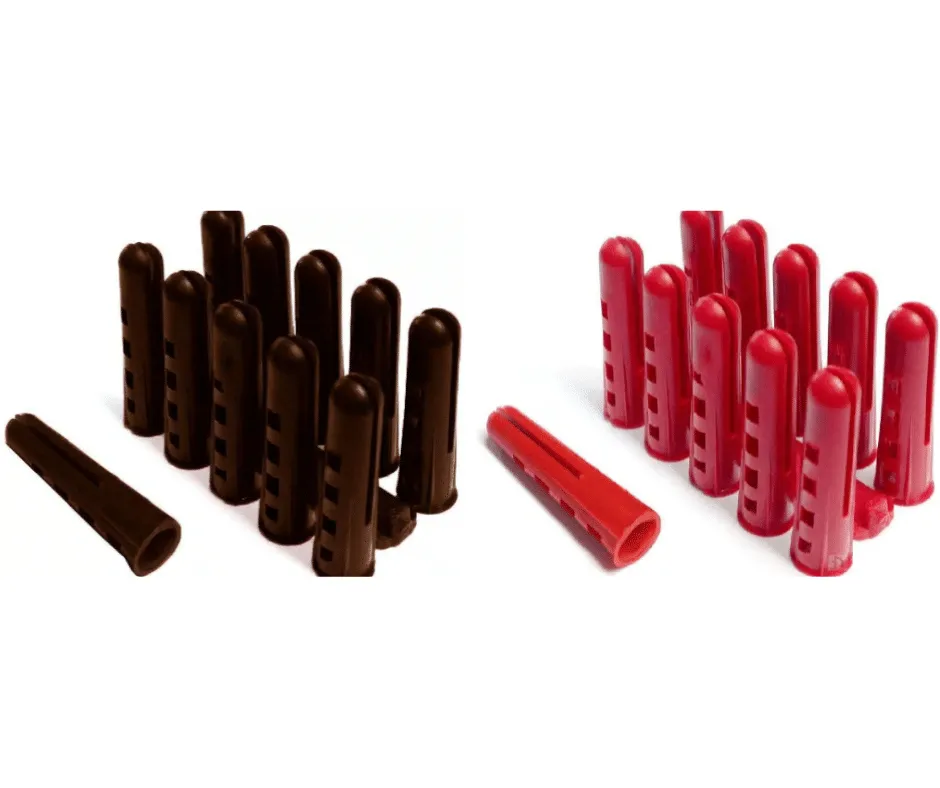
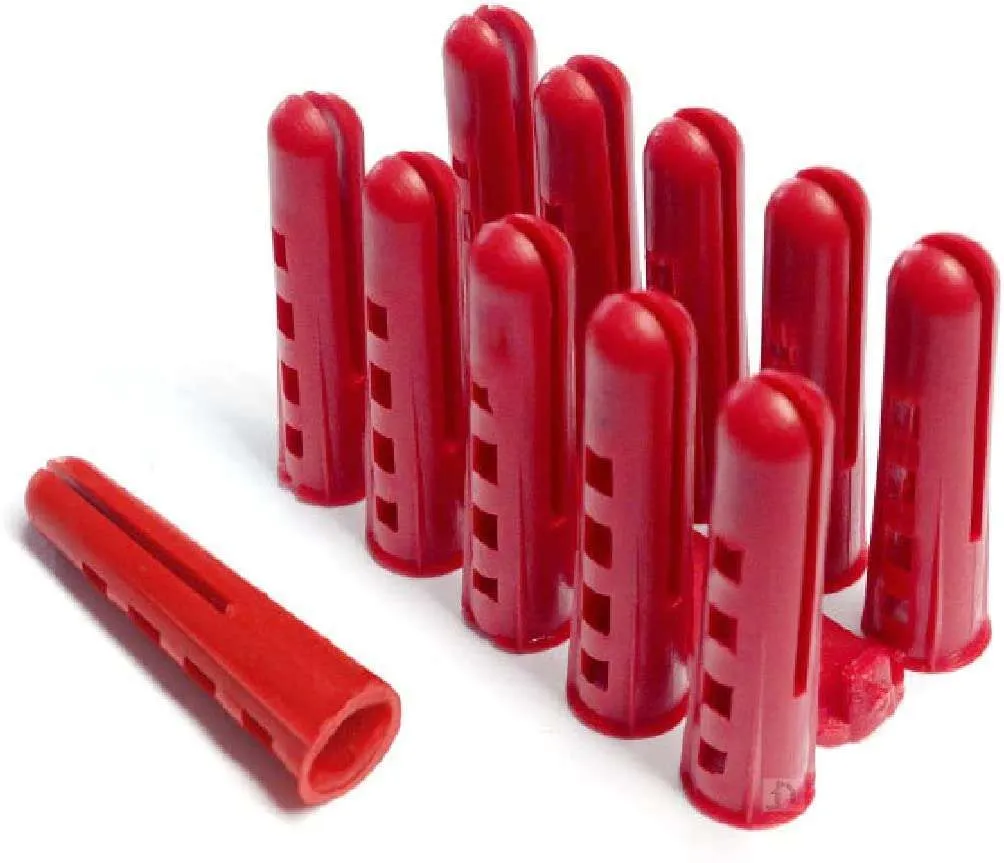
- Red plugs – for approx. 5–6 mm screws in 6 mm drilled holes.
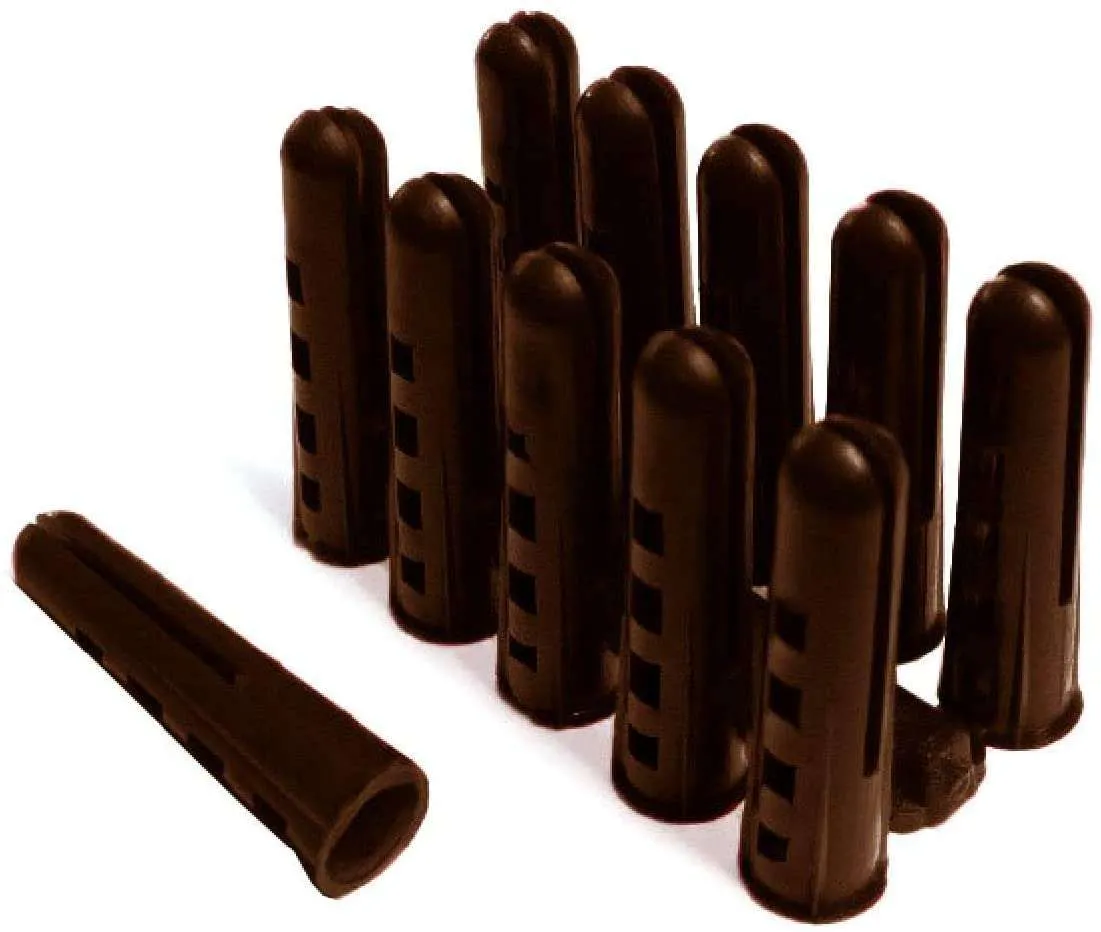
- Brown plugs – for approx. 6–8 mm screws in 7 mm drilled holes.
- Blue/grey plugs – for larger screws (e.g. 8–10 mm) in 10 mm+ drilled holes.
Always check the size chart on the packaging as dimensions may vary between manufacturers.
Typical Use Cases
- Electrical & plumbing – fixing back boxes, conduit clips, pipe clips, brackets
and trunking to masonry. - Joinery & carpentry – securing battens, door linings, frames, handrails, kitchen units and shelving to walls.
- General fitting & maintenance – mounting TV brackets, curtain rails, mirrors, hooks and light fixtures.
- Building & construction – fixing timber plates, light-duty metalwork and supports to concrete and brick.
Sizes & Compatibility
Plastic masonry wall plugs are available in a wide range of lengths and diameters. Below is a typical guide
(actual recommendations vary by brand – always confirm with the manufacturer’s chart):
| Plug Colour / Size* | Typical Drill Diameter | Typical Screw Gauge / Diameter | Typical Uses |
|---|---|---|---|
| Red | 6 mm | ~3.5–5 mm (≈ 6–10 gauge) | Light-duty fixings, clips, small brackets, light shelves |
| Brown | 7 mm | ~4.5–6 mm (≈ 8–12 gauge) | General-purpose fixings, battens, frames, medium shelves |
| Blue / Grey (large) | 8–10 mm | ~6–8 mm (≈ 12–14 gauge) | Heavier brackets, rails, small structural fixings (within capacity) |
*Colour and sizing conventions depend on manufacturer; always use the size guide on the pack you are using.
Installation Instructions
- Choose plug & screw size
- Select a plug size appropriate for the load and wall material.
- Match the plug to a suitable drill bit and screw diameter using the sizing chart.
- Mark and drill the hole
- Mark the fixing point on the wall and check for hidden services (cables, pipes) before drilling.
- Use a hammer drill or SDS drill with the correct masonry bit size.
- Drill to a depth slightly greater than the plug length + screw embedment.
- Clean the hole
- Remove dust by blowing, vacuuming or brushing out the hole.
- Clean holes improve plug expansion and holding power.
- Insert the wall plug
- Push the plug into the hole until it is flush with or just below the wall surface.
- If necessary, tap it gently with a hammer to fully seat it (do not crush or deform).
- Position the fixture
- Place the bracket, batten or fitting over the plug and align the fixing hole with the plug.
- Drive the screw
- Insert the screw and tighten using a screwdriver or drill/driver.
- The screw will expand the plug inside the hole, locking it in place.
- Do not overtighten to the point of stripping or crushing the plug/wall material.
Suitable Substrates & Limitations
- Recommended substrates:
- Solid brick (clay, concrete),
- Concrete block (dense),
- Cast concrete,
- Natural stone of adequate strength.
- Use with care / additional checks needed:
- Hollow block, perforated brick or weak materials – may require longer plugs, special hollow-wall plugs or chemical anchors.
- Plasterboard, dot & dab, insulation – standard plastic plugs are usually not suitable alone;
use appropriate plasterboard fixings or through-fix systems designed for the wall type.
- Not suitable for:
- Very soft, crumbling masonry without additional measures,
- Purely hollow cavities with no solid backing (use cavity anchors instead).
Technical & Performance Overview
Exact performance (pull-out and shear loads) depends on plug size, screw size, wall material, embedment depth
and installation quality. For safety-critical or structural fixings, consult the manufacturer’s technical data
and, where necessary, a structural engineer.
- Product type: Plastic expansion plug for masonry screws.
- Material: Durable polyethylene, polypropylene or nylon (varies by brand)
providing elasticity and expansion without brittle failure. - Sizes: Various diameters and lengths (e.g. designations equivalent to red, brown, blue/grey etc.).
- Operating principle: Screw insertion causes radial expansion of the plug against the drilled hole.
- Compatible screws: Woodscrews, chipboard screws, multipurpose screws with suitable diameter and length.
- Substrates: Solid brick, block, concrete, stone and some dense hollow materials (as tested).
- Environment: For internal and sheltered external use; long-term exposure to UV and harsh chemicals may affect some plastics.
- Standards: Many branded wall plugs are tested to relevant ETAs or EN anchor standards;
check specific manufacturer documentation if certification is required. - Storage: Store in a dry, cool place; keep sizes separated and clearly labelled.
Plastic Masonry Wall Plugs Features & Customer Benefits
- Quick, easy fixings with standard tools
No special equipment is needed – just a drill, compatible bit and screw, making installation straightforward for trades and DIYers. - Consistent, reliable performance
Quality plastic plugs offer predictable expansion and holding power compared with improvised or low-grade anchors. - Cost-effective solution
Inexpensive per fixing while providing strong, long-lasting anchorage in most solid masonry situations. - Versatile across trades
Widely used by electricians, plumbers, carpenters, builders and maintenance engineers
for everyday fixing tasks. - Neat, unobtrusive fixings
Plugs sit flush within the drill hole, allowing screws and fixtures to sit close to the wall surface.
Frequently Asked Questions – Plastic Masonry Wall Plugs
1. How do I choose the right size plug?
Match three things:
- The plug size,
- The drill bit diameter, and
- The screw diameter and length.
Use the size chart on the packaging – for example, a red plug might require a 6 mm drill
and 4–5 mm screws. Always follow the manufacturer’s recommendations.
2. Can I use plastic plugs in plasterboard?
Standard plastic masonry plugs are designed for solid materials. In plasterboard, dot & dab
or cavity walls, use:
- Dedicated plasterboard fixings (e.g. metal or nylon cavity anchors), or
- Through-fix systems that anchor into the masonry behind the board if present.
3. Why is my plug spinning in the hole?
Common reasons:
- Hole drilled too large for the plug size,
- Substrate is too weak or crumbly,
- The hole is too shallow or not cleaned, leaving dust.
Use the correct drill size, ensure a sound substrate, and clean out the dust before inserting the plug.
4. Can I reuse a wall plug?
It is generally recommended to use a new plug if a fixture is removed and replaced:
- Once a screw has expanded the plug, its shape can be distorted.
- Reusing the same plug may give reduced holding power.
5. What if my wall is hollow or very weak?
For hollow or very weak substrates, consider:
- Cavity anchors (toggle, spring, or expanding metal/nylon anchors),
- Chemical anchors in combination with sleeves (for some hollow blocks),
- Fixing into more suitable areas (e.g. studs or reinforced sections) if possible.
6. Common Uses & How to Use Plastic Masonry Wall Plugs
Common Uses:
- Mounting shelves and brackets to brick walls.
- Fixing radiator brackets, pipe clips and trunking.
- Securing door frames, linings and battens.
- Hanging pictures, mirrors, TV brackets and curtain rails on masonry.
How to Use – Quick Guide:
- Select the correct plug size and corresponding drill bit.
- Drill a straight masonry hole to the required depth; clean out dust.
- Push the plug fully into the hole until flush with the surface.
- Position your fixture and insert the correct size screw through the fixing hole into the plug.
- Tighten until the fixture is secure and firm, without over‑tightening.
| Weight | N/A |
|---|---|
| Dimensions | N/A |
| Plastic Plugs | 100 Brown, 1000 Brown, 100 Red, 1000 Red |
Be the first to review “Plastic Masonry Wall Plugs | General Purpose Expansion Plugs for Brick, Block & Concrete”
You must be logged in to post a review.
Shipping Policy
 At Always First 4 Fixings, we know that your projects rely on fast, dependable delivery. That’s why we offer flexible UK shipping options designed for tradespeople and businesses:
Fast Dispatch: Orders are processed and dispatched within 24 hours on working days.
Free shipping on all orders over £60 (UK mainland).
Express options available to keep your jobs moving.
Click & Collect: Order online and pick up at your convenience (if applicable).
Reliable Couriers: We use trusted UK carriers to ensure your fixings and fasteners arrive on time.
You’ll receive tracking details as soon as your order leaves our warehouse. Delivery times may vary depending on location and availability, but we work hard to get your order to you as quickly as possible.
At Always First 4 Fixings, we know that your projects rely on fast, dependable delivery. That’s why we offer flexible UK shipping options designed for tradespeople and businesses:
Fast Dispatch: Orders are processed and dispatched within 24 hours on working days.
Free shipping on all orders over £60 (UK mainland).
Express options available to keep your jobs moving.
Click & Collect: Order online and pick up at your convenience (if applicable).
Reliable Couriers: We use trusted UK carriers to ensure your fixings and fasteners arrive on time.
You’ll receive tracking details as soon as your order leaves our warehouse. Delivery times may vary depending on location and availability, but we work hard to get your order to you as quickly as possible.
Returns Policy
We want you to be fully confident when ordering from Always First 4 Fixings. If your supplies aren’t right for any reason, we make returns straightforward: Return unused and undamaged items in original packaging within 30 days. Don’t forget your proof of purchase or order confirmation. Once we receive your return, we’ll process your refund or exchange promptly. Certain items may have specific exclusions or conditions—please read our detailed returns policy or contact us if you have questions. Our team is always here to help ensure you get exactly what you need for the job.Related products
-

Rigifix All-In-One Dry Lined Wall Fixing Solution | Heavy-Duty Fixings for Dot & Dab Walls
£0.42 £66.65Price range: £0.50£0.42 through £79.98£66.65 Incl. VATExcl. VAT -
Delta Multi-Purpose Woodscrews | Trade-Grade General Purpose Wood Screws
£1.34 £11.62Price range: £1.61£1.34 through £13.94£11.62 Incl. VATExcl. VAT -
White Torx T30 Caps | Decorative Cover Caps for T30 Torx Screw Heads
£2.99£2.49 Incl. VATExcl. VAT -
32mm Flat Plastic Packers | Precision Levelling & Packing Shims
£2.52 £25.58Price range: £3.02£2.52 through £30.70£25.58 Incl. VATExcl. VAT -
UltraGrime Pro Multiuse Wipes XXL – 100 Pack | Heavy-Duty Extra-Large Trade Wipes
£9.30£7.75 Incl. VATExcl. VAT







Reviews
There are no reviews yet.